

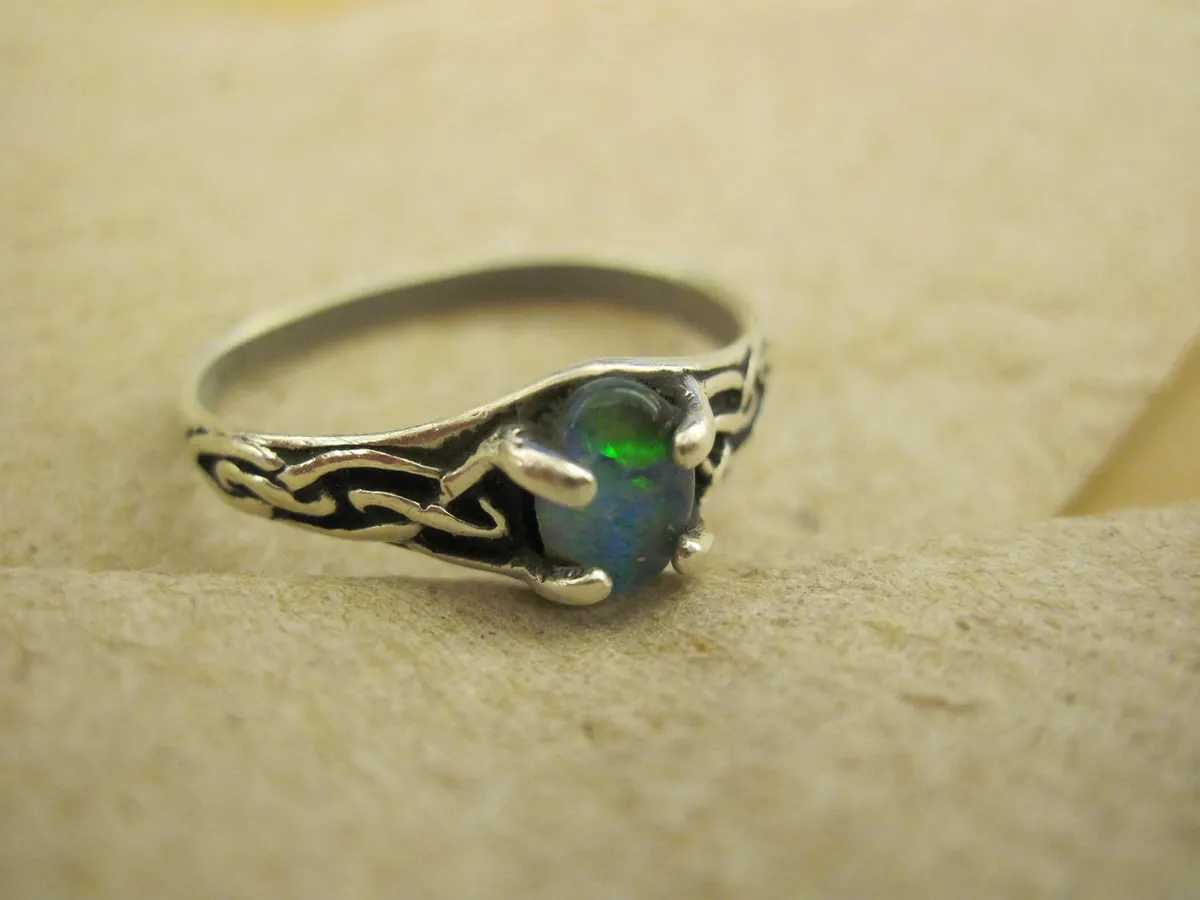
An opal can look like two different stones in the same afternoon. On the tray, under a halogen lamp, it blazes. Two steps away at the window it goes quiet and grey. Neither view is a lie. Opal is a directional stone, and its appearance depends on the light, the angle, and the colour of whatever is sitting behind it. Once you know how to read body tone, brightness and pattern, you can judge a stone for yourself in any shop, in any city. None of it requires equipment. A window, a sheet of white paper and a few minutes are enough.
The Three Qualities That Describe a Stone
Graders separate an opal into three independent qualities, and learning to keep them apart is half the skill.
Body tone is the background colour of the stone — the dark, grey or milky ground that the colour sits in. Brightness is how much light the stone gives back, and how vivid the colours look when it does. Pattern is the shape those colours make across the face: blocks, flashes, points, ribbons.
They behave independently. A stone can be dark and dull. Another can be pale and electrifying. A third can have a superb pattern that only shows from one angle. Dealers quote the three separately because they fail separately, and a weakness in one cannot be covered by strength in another. Cut, carat weight and transparency sit on top of all this, but they are easier to see.
Body Tone: The Colour Behind the Colour
Body tone describes the ground the play of colour sits in. In the Australian trade it is usually expressed on a scale from N1 to N9, with N1 the darkest and N9 the lightest. The bands are loose but genuinely useful: N1 to N4 is generally sold as black opal, N5 to N6 as dark opal, and N7 to N9 as light opal. Semitransparent stones are described as crystal opal instead, because you are looking through the material rather than at a solid ground, and the numeric scale tells you much less about them.
How to judge it
The mistake almost everyone makes is judging body tone on black velvet. Everything looks darker there, and a mid-grey stone can pass for a black one under a warm spotlight. Treat the velvet as part of the shop's lighting, not as information.
Instead, lay the stone face-up on a sheet of plain white paper and look at the areas of the face where the play of colour is quiet or absent. That is your body tone. Then lift it onto your palm and see whether the colour still holds against a lighter background. A stone that reads dark on paper and merely deep on your skin is a black opal. A stone that only looks black on black is not.
What body tone does and doesn't tell you
A dark ground gives the colour a stage. The eye reads a flash as brighter when the stone around it is quiet, which is why black opal from Lightning Ridge commands such attention. But depth alone is not value. A shallow, dead N3 does nothing at all, while a well-cut N7 with a crisp pattern can be the better stone and the better buy. Body tone sets the contrast; it does not supply the light.
Brightness: How Much Light Comes Back
Brightness is the measure of how much light the stone returns and how saturated the colours appear when it does. Dealers commonly use a five-point brightness scale, but numbering conventions differ — some call the top grade B1, others call it B5. Ask which end of the scale is which before you compare two quoted grades. It takes ten seconds and prevents a great deal of confusion.
Judge brightness in diffused daylight rather than under a jeweller's spot lamp, which flatters every stone in the cabinet. Stand near a window on an overcast day, or in open shade outside. Hold the stone face-up at arm's length. If the colours are still legible at that distance, it is a bright stone. If you have to bring it to twenty centimetres to see them, brightness is modest, whatever the label says.
Two further points. Brightness can be uneven: one blazing patch at the centre of a stone with flat, matte edges is not the same as an even glow across the whole face. And brightness changes with angle. Rotate the stone slowly and watch where the colour drops out. Every opal has a best face; the good ones hold their colour through a wide arc rather than a narrow one.
Pattern: The Shape the Colour Makes
Pattern is the geometry of the flashes. It is the quality buyers respond to first and understand last, partly because the names are descriptive rather than scientific and dealers apply them loosely.
- Harlequin: broad, roughly square blocks of colour fitting together like a mosaic. Rare, and the most sought after.
- Flagstone: similar in spirit but less regular, with wider, flatter patches.
- Broad flash: large single areas of colour that switch on and off as the stone turns.
- Rolling flash: colour that travels across the stone in a wave when you tilt it.
- Pinfire: hundreds of tiny points of colour, like scattered pins. Lively and fine, but it depends entirely on brightness to work.
- Floral and straw: softer, fan-like or needle-like arrangements, more common in light and crystal opal.
- Chinese writing: a rare pattern of dark, calligraphic shapes of colour, named for resemblance rather than origin.
Beyond the category, two things matter. Evenness: does the pattern cover the face, or is it crowded into one corner with dead potch around it? And orientation: the cutter decides which face you see, and a spectacular pattern on the side of a stone is not a spectacular stone, because you will wear it face-up.
Reading the Three Together
The three qualities multiply rather than add. Dark ground, high brightness and a coherent, even pattern together are where the value lives; miss one and the others cannot carry the stone.
Picture two opals side by side on a white tray. The first has a deep body tone, a rolling flash covering half its face, and goes flat when you turn it slightly. The second is a shade lighter, with a tight harlequin pattern that stays lit through a wide arc. Most experienced buyers would rather own the second, even though the first is nominally the darker stone.
That is not an argument for ignoring body tone. It is an argument for reading the stone rather than the label. Two traps are worth naming. One is the single flash: a stone with one spectacular patch photographs beautifully and disappoints in the hand, because the eye keeps returning to the same spot. The other is the cut. A high dome exaggerates brightness from above and hides flatness at the edges, while a shallow stone can look wide and slightly washed out. Look at the profile before you look at the top.
A Five-Minute Check Before You Buy
- Ask to see the stone out of the cabinet, and out of its setting if that is possible.
- Carry it to daylight, away from spotlights and display LEDs.
- Lay it on white paper, then on your palm. Notice which view flatters it.
- View it face-up at arm's length, then closer. Note the distance at which the colours fade.
- Turn it slowly through a full rotation and watch for dead angles.
- Check the profile: dome height, edge thickness, any sand spots or patches of potch.
- Ask the seller to state body tone and brightness in numbers, and to say which end of their brightness scale is brightest.
- Compare two or three stones side by side. Judgements made one stone at a time drift.
If you are buying remotely, ask for a short video shot in daylight, with the stone turned slowly on a white background. A still photograph tells you very little about brightness, and almost nothing about how the pattern behaves in motion.
A Habit Worth Building
Reading an opal is a skill of comparison, and it improves faster than most people expect. After fifty stones seen in daylight, the vocabulary stops being abstract. You will notice, without counting anything, that one stone has a deeper ground and a tidier pattern than the one beside it, and you will be right.
Until then, use the paper, the window and the arm's-length test, and ask for the grades in numbers. Then set the numbers aside for a moment and look at the stone the way you will actually see it — on your hand, on an ordinary grey morning, on the way to work. Buy the one that still looks alive then.
Photo: bannik1 / Pixabay